Timescales
RPVolB works best in daily or longer timescales but also works at shorter timescales. Best results are seen when multiple timescales align with volatility squeezes setting up in monthly/weekly timescales through daily 4H and hourly.
Description: Volatility Unlike Price is Often Predictable
This setup is based on the observation that unlike price, volatility is often predictable: the RPVolB looks to capitalise on volatility expansions following quiet periods of consolidation. Price can move rapidly frequently signalling the start of significant momentum moves either long or short. Most markets can spend up to 80% of the time chopping in range bound sideways movement. RPVolB looks to identify those instruments that are storing potential energy and getting ready to breakout or breakdown following these periods of consolidation. It is a relatively low risk and high reward setup with very clear parameters and triggers. The RPVolB combines three distinct indicators and uses the price and volume behaviour around these parameters in order to define clear and actionable signals. Those three indicators are the Bollinger bands, the Keltner Channels and the Moving Average Convergence-Divergence Indicator (MACD). All of these are moving average based lagging indicators, What makes the RPVOLB predictive is the peculiar way they interact to signal that potential energy is being stored and will soon be released as the kinetic energy needed to produce momentum moves.
[perfectpullquote align="left" bordertop="false" cite="" link="" color="#f00000" class="" size="22"] One simple way to think of this is to imagine a spring being coiled increasing the amount of stored energy: once released the spring converts that energy into rapid directional movement[/perfectpullquote] Two volatility measures are compared – the BBs which typically react rapidly to changes in price as they are based on standard deviations of moving averages and the Keltner Channels which react more slowly to price changes as they are based on ATR multiples of the underlying moving average. To define extraordinary drops in volatility , the RPVolB requires that the BBs fall inside the Keltner Channels in a volatility squeeze. These are typically short lived but the longer the squeeze remains, the bigger the resulting move once volatility begins to expand.
[perfectpullquote align="full" bordertop="false" cite="" link="" color="" class="secondclass" size="18"]The setup is triggered either when the BBs move back outside the KCs as price and volume move rapidly or if price moves sharply (often intraday) and pierces either the upper (breakout) or lower (breakdown) Bollinger Band . The third components of the RPVolB is a MACD based directional momentum indicator which will indicate if the move is long or short.[/perfectpullquote]
Finally, the magnitude of the initial price moves and the volume underpinning them gives further evidence of the strength of the move as does behaviour of shorter timescale moving averages. All of these are discussed in more detail below.
Setup Parameters and Trigger
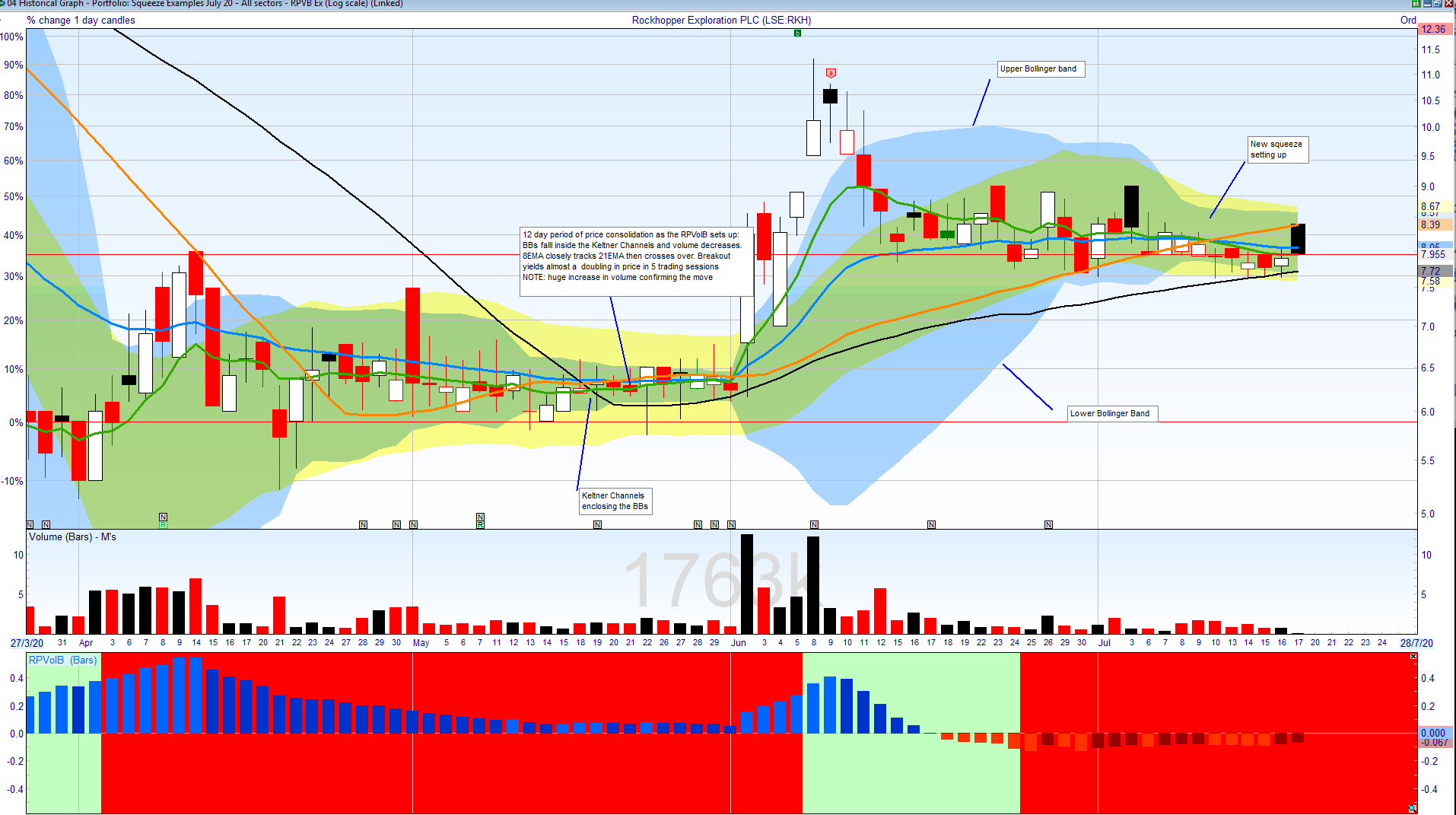
The precursor to the volatility breakout is a period of relatively low volatility which can be described with the following parameters. A recent example is shown for Rockhopper in Figure 1
- Bollinger Bands Narrow and Flatten. Bollinger bands (BBs) are a good measure of price volatility, periods of low volatility are indicated when the BBs narrow and flatten.
- In order to generate a signal that a volatility squeeze is occurring, we set a prerequisite that the BBs contract sufficiently to fall inside the Keltner Channels as price action goes quiet.
- When 1) and 2) are satisfied then the volatility squeeze is in play and the RPVolB is setting up. This is often further evidence by even more tightening of price and a drop in volume
- The RPVolB is triggered when the BBs leave the Keltner channels as volatility suddenly expands and price makes a significant move either long or short: volume will also increase rapidly as the supply/demand equilibrium has been displaced by some catalyst (news, earnings, broker ratings)
- In a clean breakout, the slope of the MACD histogram and the 8/21EMA behaviour sets the direction to go either long or short. The stop can then be set as the price of the opposite Keltner Channel to the move on breakout. When price follows through in days 2, 3 and further: stops can be trailed and position size further scaled-in. If price continues to advance strongly in days 5 and 6, partial profits can be booked.
Notes and Exceptions: The Head fake
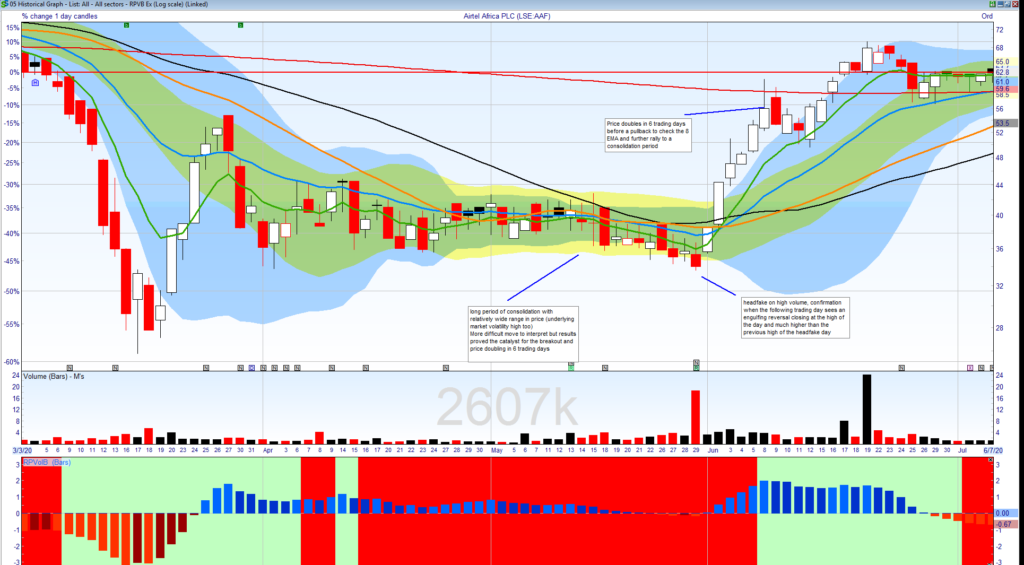
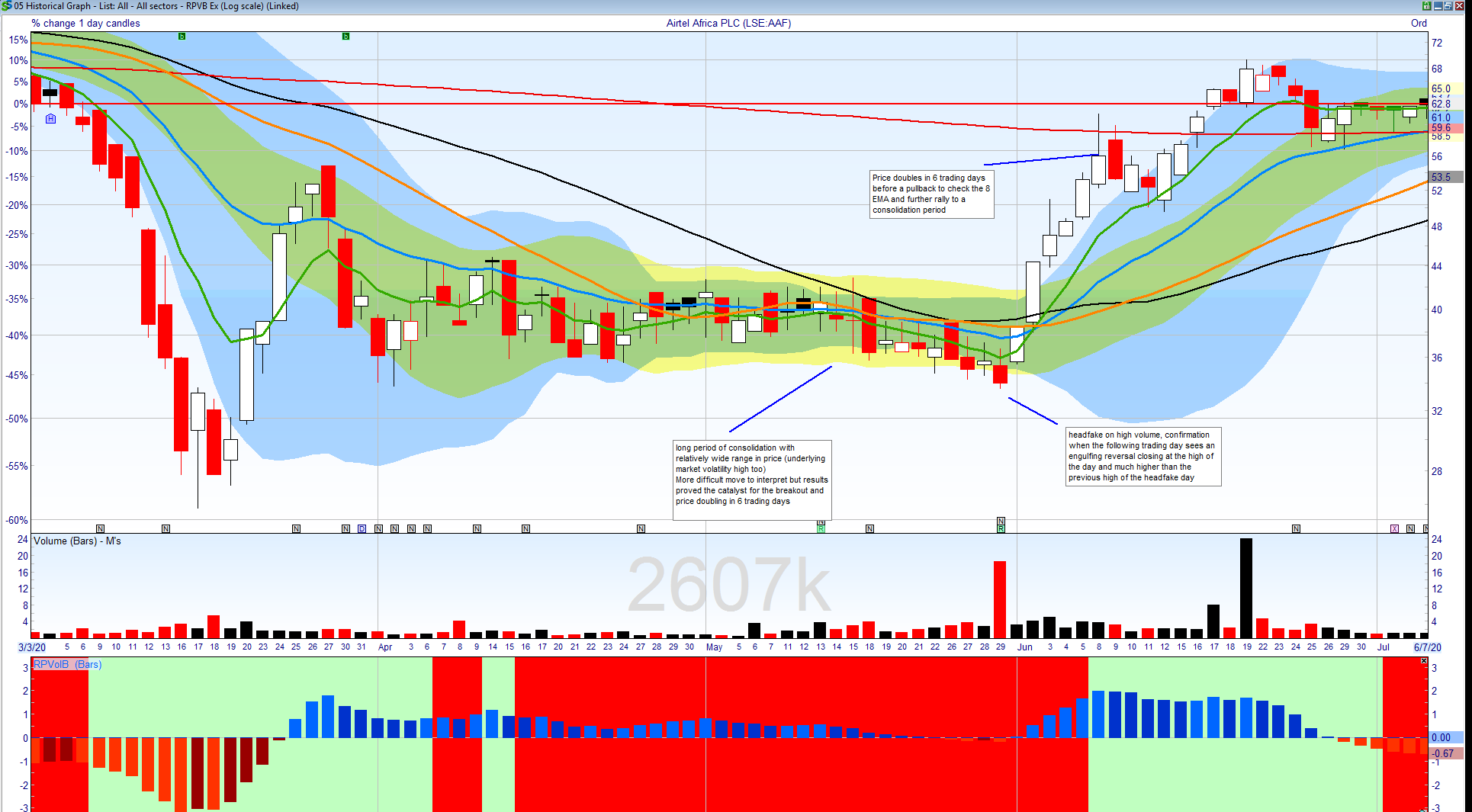
John Bollinger cited the head fake in his original work on Volatility squeezes. These are “false” breakouts in the opposite direction to the eventual direction of the volatility expansion. The phenomenon is best illustrated by an example shown in Figure 2 for Airtel Africa (AAF)
A volatility squeeze started to form in later April 2020 with the BBs contracting and dropping inside the KCs: unlike a typical volatility contraction, price volatility was somewhat elevated but compared to the earlier March, April period was significantly reduced (as was overall market volatility). AAF updated with on results on 29 May ’20 ending the consolidation period and appeared to form a short RP Vol B on high volume. However, the following trading day marked a complete reversal enclosing the headfake day and closing at the high. AAF went on to double in price in 6 trading days, such is the power of these volatility breakouts. While headfakes can be difficult to spot a few rules help
- A headfake is by definition unexpected and will often form even as you expect price to be breaking out and not down
- Wait for the day after the headfake , if price opens above the mid of the headfake day then take a long at less than maximum stake. If price rallies into the day then add. If price forms an inside day then await subsequent days for direction to establish
- Assuming price continues to rally on Day 3 onwards scale-in to the position or hold waiting for take-profit levels (taking some profit off at 100% gain is always sensible and reduce the risk for the remaining stake (or eliminates it entirely on taking 50%)
- Markets that have a tendency to form a headfake will often have done this in the past so looking sufficiently left on the charts should give evidence you are dealing with a faker. You can then be prepared and can design your entry based on the reversal
RPVOLB Trade Management
This setup is characterised by high reward to risk ratios and so can be traded more aggressively once confirmation is obtained. I tend to build a position in to a developing breakout or breakdown which (with the exception of headfakes which are in the minority) give clear signals and directional intent.
Entry:
The trigger to enter is when the BBs leave the KCs with the momentum indicator showing direction and with other enhancers listed below to improve confidence. While there is potential to capture more of the move by entering while the volatility squeeze is still in play, this increases risk and trade duration which is then susceptible to broader market volatility and risk.
Stop
The stop can be set as below the opposite KC band (except for headfakes)
Targets
RPVolBs are by definition explosive so accurate target setting can be tricky and is often dependent on the nature of the catalyst: see Trade Duration below.
Trade Duration
RPVolBs tend to last from 4 to 7 periods of the timescale. That doesn’t mean the price move ends there so taking partial profit and trailing a stop is a useful way to remain in the trade to capture more of a move with reduced risk. This should be context dependent so the nature of the catalyst should be considered: if it involves a significant rerating of a stock or a major change in macro then the resulting move may be much longer lived. That context should be borne in mind when putting the trade on and may influence the type of capital you are using and the expected duration
Take Profits
I tend to scale-out of VolBs but that is dependent on the magnitude of the move and proximity to major resistance or historical reversal areas on the chart. Behaviour of price and volume will also give clues to how tight hands are in the move beyond. Given the relative magnitude of moves, 8 and 21EMAs may well be a significant distance form price so a protective take-profit stop at a close below an 8EMA is often a good measure
RPVOLB Trade Enhancers
Like any trading and most setups, the best trades are often the result of the confluence of multiple enabling factors. Below are a series of enhancers that will add to confidence and can influence the position size one takes
- Phase 2 or Phase 3 stocks as a volatility breakout often occurs after accumulation has hit a tipping point where the loose hands have been absorbed and any incremental demand is met by poor supply in that price range: this is what causes the rapid expansion in price to new levels where supply becomes available. If there is a driving catalyst supporting the move then the new equilibrium point for supply and demand may be some distance from the breakout point. These are the big moves that make serious profits.
- Supported by a strong trend : so for a long RPVolB , moving averages are stacked in their order of magnitudes 8EMA>21EMA>50MA>200MA. For short positions then weakness should be apparent.
- RPVolBs signalling a reversal after basing can give some of the most explosive: look for a volatility contraction after a basing period of distribution and accumulation. When the RPVOlB fires these can rocket rapidly especially if there is a significant short interest on that stock. Superimposing a short squeeze on an volatility breakout is a turbo boosted
- On the handle of a cup and handle or a double bottom
RPVOLB References and Further Reading
- “Bollinger on Bollinger Bands”, John Bollinger, 256 pages, Aug 2001 : McGraw-Hill Education ISBN-10: 0071373683
- How To Make Money In Commodities, Chester Keltner, 230 pages, Keltner Statistical Service (1 Jan. 1960)
- Bollinger Bands overview at Stockcharts
- Keltner Channels overview at Stockcharts


Set Up ID: RPVOLB - RP Volatility Squeeze Breakout/Breakdown
The RPVolB setup is a volatility expansion setup based on the original Bollinger squeeze setup described by John Bollinger in 2002. There have been numerous additions and improvements to the original work of which RPVolB is but one of those. The details below and supporting data on runprofits.com are used to identify volatility squeezes that occur in UK markets.